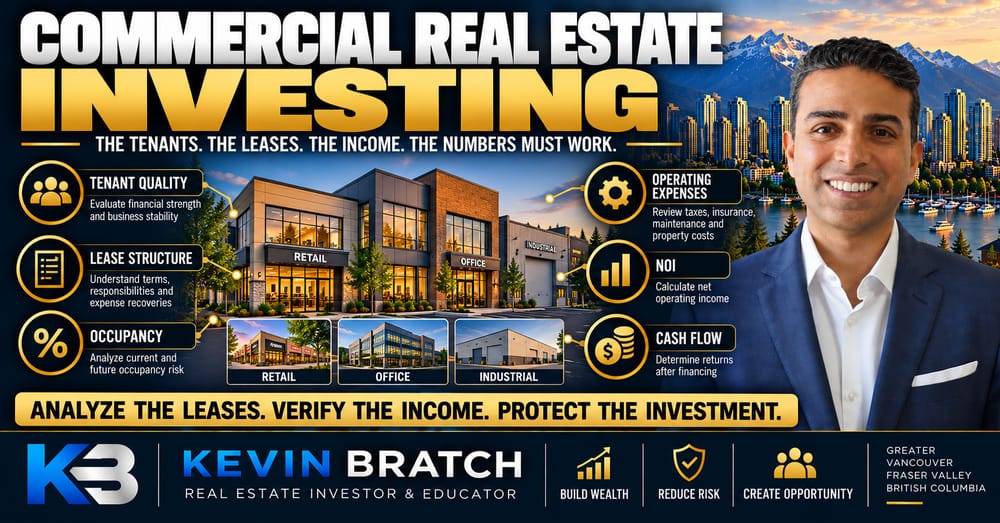
Commercial real estate investing can provide opportunities to generate rental income, build equity and acquire properties whose value is closely connected to their financial performance. But evaluating commercial property requires a different approach from analyzing a traditional residential rental.
When buying a house, investors often focus on comparable sales, market rent, mortgage payments and property condition.
Commercial real estate introduces additional considerations, including tenant creditworthiness, lease structure, operating expense recoveries, remaining lease terms and capitalization rates.
A commercial property may appear attractive because of its location, building quality or rental income. However, the investment only makes sense when the underlying numbers and risks support the purchase.
Before buying, investors should understand exactly what income the property produces, who is responsible for expenses, how secure the tenant relationships are and what happens when leases expire.
Don't just buy the building. Analyze the tenants, the leases, the income and the long-term investment potential.
For a broader overview, visit my Commercial Real Estate Investing Guide, which includes interactive calculators for commercial cash flow, property valuation and investment risk.
1. Understand the Different Types of Commercial Real Estate
Commercial real estate covers several property categories. Each has different tenants, operating requirements, market dynamics and investment risks.
Retail Properties
Retail properties include storefronts, shopping plazas, neighbourhood retail centres and standalone commercial buildings.
Investors should evaluate foot traffic, visibility, parking, accessibility, surrounding demographics and the financial strength of retail tenants.
Office Buildings
Office investments may include small professional buildings, suburban office complexes and larger downtown office properties.
Important considerations include tenant demand, building quality, layout flexibility, operating costs, lease incentives and the ability to attract replacement tenants.
Industrial Properties
Industrial real estate may include warehouses, distribution facilities, manufacturing buildings and flex-industrial spaces.
Investors often examine ceiling heights, loading access, electrical capacity, truck circulation, zoning and proximity to transportation networks.
Mixed-Use Properties
Mixed-use properties combine different uses, such as ground-floor retail with residential or office space above.
These buildings may offer multiple sources of income, but they can also introduce different leasing requirements, building systems and management considerations.
For every property type, the goal is to understand who will occupy the space, what they can realistically pay and how the building supports their operations.
2. Calculate the Property's Actual Rental Income
Commercial rent is frequently quoted differently from residential rent.
For example, a commercial listing might advertise rent at $35 per square foot annually rather than quoting a monthly amount for the entire property.
Consider a hypothetical commercial property with:
- 10,000 square feet of rentable area
- Annual base rent of $35 per square foot
- Full occupancy under the initial calculation
= $350,000 ANNUAL BASE RENT
This is the potential annual base rental income before vacancy and collection losses.
Review the Rent Roll
Before buying, obtain a detailed rent roll showing:
- Each tenant and occupied unit
- Rentable square footage
- Current base rent
- Additional rent or expense recoveries
- Lease commencement and expiry dates
- Renewal options
- Security deposits and guarantees
- Known arrears or collection issues
Compare the rent roll with signed leases, amendments and actual collection records.
Advertised rental income is not the same as verified, collectible income.
3. Understand Commercial Lease Structures
One of the most important differences between commercial and residential investing is how lease agreements allocate expenses between landlords and tenants.
Commercial lease terms can materially affect the property's net income.
Gross Lease
Under a gross lease, the tenant generally pays an agreed rent while the landlord covers specified operating expenses.
The exact responsibilities depend on the contract.
Net Lease
Under a net lease, tenants may pay base rent plus some property expenses, such as taxes, insurance or maintenance.
Triple Net Lease (NNN)
A triple net lease commonly requires the tenant to reimburse or pay specified property taxes, insurance and maintenance costs in addition to base rent.
However, the label "triple net" does not mean the landlord has no expenses or responsibilities.
Roof replacements, structural repairs, capital expenditures, administration charges and other obligations depend on the actual agreement.
Modified Gross Lease
A modified gross lease divides expenses between landlord and tenant according to negotiated terms.
Because commercial leases can vary significantly, investors should never rely solely on the lease category.
The actual lease agreement matters more than the name used to describe it.
4. Evaluate Tenant Quality and Lease Expiry Risk
Commercial property value can depend heavily on the stability of the rental income.
A building with a financially strong tenant committed to a long-term lease may have a different risk profile from an otherwise similar building with a struggling tenant approaching lease expiry.
Questions to Ask About Tenants
- How long has the tenant operated the business?
- What is the tenant's payment history?
- Is the business financially stable?
- Does the tenant provide financial reporting?
- Are there personal or corporate guarantees?
- How much time remains on the lease?
- Are renewal options available?
- Could the space be leased to another tenant?
Tenant Concentration Risk
Imagine a commercial building with three tenants.
One tenant produces 70% of the rental income.
If that tenant leaves, the property's financial performance could change dramatically.
Investors should understand how much income depends on each tenant and whether vacancies could be filled within a reasonable period.
Lease Rollover
Lease rollover refers to leases approaching expiry.
Several major leases expiring within a short period can create substantial vacancy and leasing risk.
Review the lease expiry schedule before making an investment decision.
5. Calculate Net Operating Income
Net operating income, commonly called NOI, is one of the most important financial measurements in commercial real estate investing.
NOI measures property income after operating expenses but before mortgage debt service, income taxes and certain non-operating items.
− OPERATING EXPENSES
= NET OPERATING INCOME (NOI)
Operating expenses may include:
- Property taxes
- Building insurance
- Repairs and maintenance
- Utilities
- Property management
- Landscaping and snow removal
- Common-area maintenance
- Administrative and operating costs
Some expenses may be recoverable from tenants, depending on the leases.
Investors should account for both the expenses incurred and the reimbursements actually expected to be collected.
Be careful not to double-count tenant reimbursements or assume all operating costs are recoverable.
For more on the fundamentals, see my Cash Flow Real Estate Investing Guide.
6. A Practical Commercial Real Estate Investment Example
Let's analyze a hypothetical commercial property using the same starting assumptions as the cash-flow calculator on my commercial investing pillar page.
Assume:
| Property Assumption | Amount |
|---|---|
| Purchase price | $3,000,000 |
| Rentable area | 10,000 sq. ft. |
| Annual base rent | $35/sq. ft. |
| Gross annual base rent | $350,000 |
| Vacancy allowance | 5% |
| Expected tenant expense recoveries | $50,000 |
| Annual operating expenses | $100,000 |
| Annual mortgage payments | $120,000 |
Step 1: Calculate Effective Base Rental Income
Gross annual base rent is $350,000.
Using a 5% vacancy allowance:
= $332,500 EFFECTIVE BASE RENT
Step 2: Add Tenant Expense Recoveries
Assume the landlord expects to collect $50,000 in annual tenant reimbursements, already adjusted for expected non-collection.
= $382,500 EFFECTIVE PROPERTY INCOME
Step 3: Deduct Operating Expenses
Annual operating expenses total $100,000.
= $282,500 ANNUAL NOI
Step 4: Deduct Mortgage Payments
= $162,500 ESTIMATED ANNUAL CASH FLOW
| Annual Property Performance | Amount |
|---|---|
| Gross base rental income | $350,000 |
| Vacancy allowance | −$17,500 |
| Effective base rental income | $332,500 |
| Tenant expense recoveries | +$50,000 |
| Total effective income | $382,500 |
| Operating expenses | −$100,000 |
| Net operating income | $282,500 |
| Annual mortgage payments | −$120,000 |
| Estimated annual cash flow | $162,500 |
Estimated monthly cash flow is approximately $13,542.
This example is hypothetical and excludes income taxes, extraordinary expenses, additional capital expenditures and reserves. It also assumes the specified tenant reimbursements are collectible after applicable vacancy and collection losses.
What Does the Example Tell Us?
The property appears to generate positive cash flow under the stated assumptions.
But that alone does not establish whether it is a good investment.
We still need to evaluate the tenants, leases, market rents, financing, building condition, capital expenditure requirements and resale value.
Strong projected cash flow is valuable only when the underlying income and expenses are realistic.
7. Understand Commercial Cap Rates and Property Valuation
Commercial property values are often evaluated using income-based valuation methods.
One common metric is the capitalization rate, or cap rate.
= CAPITALIZATION RATE
Using the example above:
= 9.42% PURCHASE CAP RATE
This is an illustrative calculation, not a statement about prevailing commercial cap rates in Greater Vancouver.
Using Cap Rates to Estimate Value
Investors can also rearrange the formula:
= INDICATED PROPERTY VALUE
Suppose another commercial property generates $150,000 in annual NOI.
At a hypothetical 5% cap rate:
= $3,000,000 INDICATED VALUE
This is an income-capitalization estimate, not a substitute for a professional appraisal.
How Cap Rate Changes Affect Value
Consider the same $150,000 NOI under different assumed cap rates.
| Assumed Cap Rate | Indicated Value |
|---|---|
| 4.5% | $3,333,333 |
| 5.0% | $3,000,000 |
| 5.5% | $2,727,273 |
| 6.0% | $2,500,000 |
| 7.0% | $2,142,857 |
The property's NOI remains unchanged in this illustration, yet the indicated value varies considerably.
This demonstrates why commercial investors must evaluate both operating performance and market valuation assumptions.
For interactive scenarios, visit the Commercial Property Valuation Calculator on my investing guide.
Interested in Real Estate Investment Opportunities?
Join my private investor list for selected off-market opportunities, educational resources, investment strategies and market insights.
JOIN THE PRIVATE INVESTOR LIST →8. Analyze Commercial Financing and Debt Coverage
Commercial financing can differ from traditional residential mortgages.
Lenders may place significant emphasis on property income, lease quality, borrower strength, loan-to-value ratios and debt-service coverage.
Debt-Service Coverage Ratio
Debt-Service Coverage Ratio, or DSCR, compares annual NOI with annual debt service.
= DSCR
Using our commercial example:
= 2.35× DSCR
In this hypothetical case, the property's NOI is approximately 2.35 times the annual mortgage payments entered.
A DSCR above 1.00 indicates that NOI exceeds the specified debt service. However, lenders may require a higher ratio and may calculate qualifying income or debt service differently.
Review the Complete Financing Structure
- Down payment and equity requirements
- Interest rate and amortization
- Loan term and renewal risk
- Prepayment provisions
- Required reserves
- Guarantees and covenants
- Tenant and lease requirements
- Refinancing flexibility
Commercial investors may also explore private lending, joint ventures or other appropriate financing structures.
For more information, see my Structuring Real Estate Deals Guide.
9. Complete Commercial Property Due Diligence
Before committing to a commercial acquisition, investors should verify both the property's financial performance and its physical and legal condition.
Financial Due Diligence
- Current rent roll
- Signed leases and amendments
- Tenant payment records
- Operating statements
- Property tax information
- Insurance costs and coverage
- Utility and maintenance expenses
- Expense reimbursement reconciliations
- Historical vacancy and leasing costs
Physical Due Diligence
- Roof and building envelope
- Structural condition
- Heating, ventilation and cooling systems
- Electrical capacity
- Plumbing and drainage
- Fire and life-safety systems
- Parking areas and access
- Elevators and mechanical equipment, if applicable
- Deferred maintenance
- Environmental concerns
Legal and Regulatory Due Diligence
- Property title and registered charges
- Zoning and permitted uses
- Building permits and occupancy requirements
- Environmental reports and potential contamination
- Lease assignment and renewal provisions
- Tenant improvement obligations
- Applicable strata documents, if relevant
- Tax considerations, including applicable GST
Commercial properties can carry environmental and regulatory obligations that are less obvious during a basic walkthrough.
Qualified legal, environmental, inspection, accounting and financing professionals should be involved where appropriate.
10. Understand Tenant Improvements and Leasing Costs
Commercial landlords may need to invest significant money to attract or retain tenants.
These costs can include:
- Tenant improvement allowances
- Interior buildouts
- Leasing commissions
- Rent-free periods
- Marketing and legal expenses
- Building upgrades required for new tenants
Suppose a commercial unit becomes vacant and requires $100,000 in improvements before it can be leased again.
Even if the replacement tenant agrees to attractive rent, the investor must consider the time and cost required to secure that income.
Capital expenditures and leasing costs should be incorporated into investment cash-flow forecasts even when they are excluded from conventional NOI calculations.
11. Look for Realistic Value-Add Opportunities
Some commercial properties may offer opportunities to improve income or operating efficiency.
Potential strategies include:
- Leasing vacant space
- Renegotiating leases where appropriate
- Improving tenant retention
- Reducing avoidable operating costs
- Improving building energy efficiency
- Reconfiguring space where permitted
- Addressing deferred maintenance
- Upgrading common areas and property presentation
However, increasing NOI does not guarantee a corresponding increase in value.
The cost of improvements, market cap rates, lease quality and property demand all influence the outcome.
A Simple NOI Improvement Example
Suppose an investor increases sustainable annual NOI from $150,000 to $172,500.
At an unchanged hypothetical 5% cap rate:
= $3,450,000 INDICATED VALUE
Compared with the original $3 million indicated value, this represents a mathematical increase of $450,000.
But that is not necessarily $450,000 in investment profit. The calculation excludes the costs required to achieve the improvement, transaction expenses and potential changes in cap rates.
12. Stress-Test Commercial Investment Risk
Commercial properties can be sensitive to vacancy, tenant failure, operating expenses, interest rates and capitalization rates.
Consider a hypothetical property producing $195,000 in annual NOI.
At a 6% cap rate, the indicated value is:
= $3,250,000
Now suppose annual NOI falls to $150,000 and the assumed market cap rate increases to 7%.
= $2,142,857
That is a substantial change in indicated property value.
The example demonstrates how operating performance and market valuation can move against an investor at the same time.
Questions to Stress-Test
- What happens if the largest tenant leaves?
- What if vacancy lasts 12 months?
- What if a major HVAC system fails?
- What if insurance and property taxes increase?
- What if financing costs rise at renewal?
- What if the market cap rate increases?
- What if the property requires significant tenant improvements?
A commercial property should be evaluated for how it performs when assumptions change, not just when everything goes according to plan.
Use the Commercial Investment Risk Analyzer on my pillar page to explore more detailed scenarios.
13. Commercial Real Estate vs. Residential Investing
Commercial and residential properties can both play roles in an investment portfolio, but the analysis and management requirements differ.
| Consideration | Commercial | Residential |
|---|---|---|
| Income | Business or commercial tenants | Residential tenants |
| Lease terms | Often more individually negotiated | Subject to residential tenancy rules |
| Expense allocation | May include tenant reimbursements | Often more landlord-paid expenses |
| Valuation | Frequently income-focused | Often strongly influenced by comparable sales |
| Vacancy | Can require longer leasing periods | Varies by local housing market |
| Financing | Often tied closely to NOI and lease quality | Depends on property type and borrower |
Neither category is automatically superior. Investors should select property types based on capital, experience, objectives and risk tolerance.
Explore my guides to Multi-Family Real Estate Investing and Development Land Investing for additional comparisons.
14. Common Commercial Real Estate Investing Mistakes
Focusing Only on the Cap Rate
A high cap rate may reflect additional risk rather than an unusually attractive opportunity.
Ignoring Tenant Financial Strength
Rental income is only as dependable as the tenant's ability and obligation to pay.
Misunderstanding Lease Responsibilities
Investors may incorrectly assume that all expenses are reimbursed by tenants.
Underestimating Vacancy Costs
Commercial vacancies may require marketing, tenant improvements, leasing commissions and extended periods without income.
Ignoring Capital Expenditures
Major building systems can require substantial investment even when current NOI looks strong.
Using Aggressive Financing
High debt service can leave little flexibility when operating performance weakens.
Failing to Plan the Exit
Investors should consider future buyer demand, lease expiries, refinancing conditions and possible changes in cap rates.
15. Commercial Real Estate Investment Checklist
Before Making an Offer
- Location: Does the area support the property's intended commercial use?
- Tenants: Are the businesses financially dependable?
- Leases: Have all important terms and obligations been reviewed?
- Income: Is the rent roll verified?
- Expenses: Are recoveries and landlord costs accurately calculated?
- NOI: Does the property generate sustainable operating income?
- Valuation: Is the asking price supported by market evidence?
- Financing: Can the investment support its debt obligations?
- Condition: Are major building systems and future repairs understood?
- Risk: Have vacancy and downside scenarios been evaluated?
- Exit: Is there a realistic holding, refinancing or sale strategy?
Frequently Asked Questions About Commercial Real Estate Investing
What is commercial real estate investing?
Commercial real estate investing involves purchasing properties used for business or income-producing purposes, such as retail, office, industrial and mixed-use buildings. Investors may seek rental income, equity growth and long-term appreciation.
How do you calculate commercial property cash flow?
Start with rental income, subtract vacancy and collection losses, add applicable tenant reimbursements and deduct operating expenses to determine NOI. Then subtract debt service and account for other cash requirements, such as capital expenditures and leasing costs.
What is a good commercial real estate cap rate?
There is no universal good cap rate. Appropriate rates depend on location, tenant quality, lease terms, building condition, market conditions and investment risk. Compare a property's cap rate with relevant current market evidence.
What is the difference between NOI and cash flow?
NOI is property income after operating expenses but before financing costs and income taxes. Cash flow accounts for financing payments and, in a complete investor analysis, other applicable cash expenses and reserves.
What is a triple net commercial lease?
A triple net lease generally requires tenants to pay base rent plus specified property expenses, commonly including taxes, insurance and maintenance. Exact obligations depend on the lease wording.
Why is tenant quality important in commercial investing?
Tenant financial strength affects the reliability of rental income. A financially weak tenant may create arrears, vacancy, leasing costs or reduced property value.
How are commercial investment properties valued?
Commercial properties may be valued using income capitalization, discounted cash-flow analysis, comparable sales and other methods. NOI and market cap rates are common inputs, but they do not replace a professional appraisal.
What should investors check before buying commercial property in BC?
Investors should review leases, tenant financial information, operating statements, zoning, title, environmental conditions, property inspections, insurance, financing and applicable tax requirements. Qualified professional advice is important.
Final Thoughts: Commercial Investing Starts With the Income
Commercial real estate investing can provide opportunities to acquire income-producing assets, build equity and potentially increase property value through improved operations.
But commercial property analysis involves much more than evaluating the building itself.
Investors need to understand the tenants, leases, rental income, operating expenses, financing and risks that affect the property's long-term performance.
Before purchasing, verify the rent roll, read the leases, inspect the property, calculate NOI, review the financing and stress-test the investment.
Most importantly, be willing to walk away when the numbers do not support the purchase.
ANALYZE THE LEASES. VERIFY THE INCOME. PROTECT THE INVESTMENT.
Want to Discover More Real Estate Investment Opportunities?
Join my private investor list for selected off-market opportunities, investment education, market insights and practical real estate strategies.
JOIN THE PRIVATE INVESTOR LIST →Greater Vancouver • Fraser Valley • British Columbia
About the Author: Kevin Bratch is a Canadian real estate investor and educator with more than 20 years of real estate experience, focused on investment education, off-market opportunities and practical real estate strategies in British Columbia. Learn more about Kevin.
Disclaimer: This article is for educational purposes only and does not constitute investment, legal, tax, appraisal or financing advice. All financial examples are hypothetical. Actual results depend on property conditions, lease agreements, market conditions, financing and other risks. Consult qualified professionals before making investment decisions.