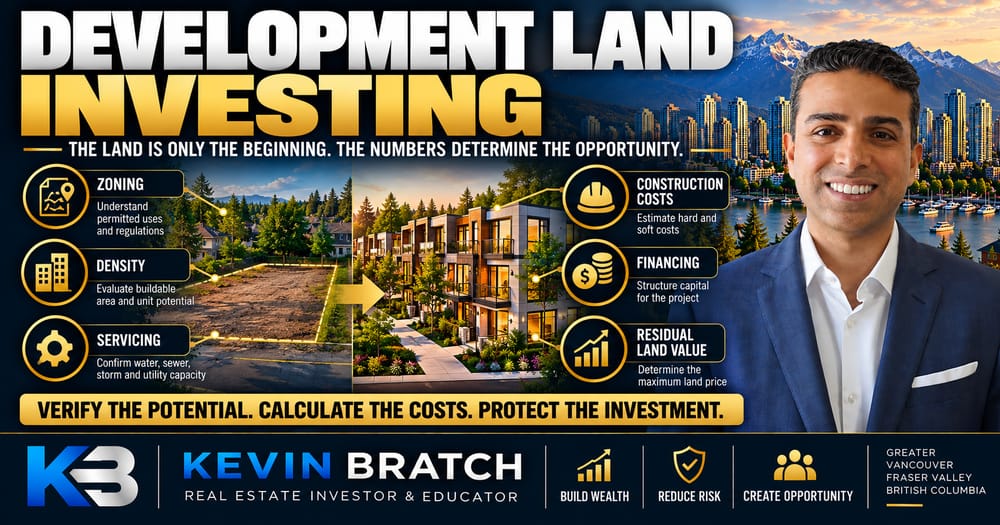
Development land can look like one of the most exciting opportunities in real estate investing. A vacant lot, an older house on a large parcel or an underused commercial property might appear to offer the potential for new homes, townhouses or a multi-unit residential project.
But identifying land with development potential is only the beginning.
Before purchasing, an investor needs to determine what can actually be built, what approvals are required, how much the project will cost, how long development could take and what the completed project might be worth.
In British Columbia, where land values, construction costs, municipal regulations and housing demand can vary significantly between communities, these questions become particularly important.
A property can have attractive development potential and still be a poor investment at the wrong purchase price.
Don't buy land based on what you hope to build. Buy based on what you can verify, finance and execute.
For a broader introduction, visit my Development Land Real Estate Investing Guide, which includes interactive development feasibility, zoning and risk-analysis tools.
1. What Makes Land a Development Opportunity?
Development land is property that may support new construction, subdivision, redevelopment or another change in use.
Examples might include:
- Vacant residential lots
- Older homes on larger parcels
- Properties with potential for additional dwelling units
- Land near transit and employment centres
- Underused commercial properties
- Potential townhouse or small apartment sites
- Properties that may qualify for subdivision
- Sites where existing buildings could be replaced or repositioned
But not every underused property is developable.
Development potential depends on a combination of legal permissions, physical conditions, servicing, market demand and financial feasibility.
Potential Is Not the Same as Approval
A parcel might appear suitable for a six-unit development based on its size or neighbourhood.
That does not mean six units are automatically permitted, physically feasible or economically viable.
Investors need to distinguish between:
- Existing entitlements: What is currently permitted under applicable rules.
- Conditional approvals: What may be possible after required applications and reviews.
- Speculative potential: What could become possible if policies or zoning change.
These categories carry different levels of uncertainty and risk.
2. Understand Zoning Before Calculating Value
Zoning is one of the first things investors should investigate when evaluating development land.
Municipal zoning and related development regulations may influence:
- Permitted property uses
- Number of dwelling units
- Building height
- Floor area and density
- Setbacks
- Lot coverage
- Parking and access requirements
- Subdivision possibilities
- Other site-specific restrictions
In British Columbia, provincial housing legislation and municipal implementation may also affect residential development opportunities. However, investors should confirm the rules currently applicable to the specific parcel rather than assuming that a provincial policy guarantees a particular project.
What Is Floor Space Ratio?
Floor Space Ratio, often abbreviated FSR, compares the floor area counted under applicable rules with the area of the development site.
= THEORETICAL GROSS FLOOR AREA
For example, consider a hypothetical site containing 10,000 square feet of land with an assumed FSR of 2.5.
= 25,000 SQ. FT.
This represents a theoretical gross floor area under the assumed calculation.
It is not confirmation that a 25,000-square-foot building will be approved or can physically fit on the site.
Height, setbacks, building form, site access, parking, servicing and other regulations may reduce practical development capacity.
Gross Floor Area vs. Saleable Area
Another important distinction is the difference between total building area and the area that can generate sale or rental revenue.
Buildings may require hallways, stairs, mechanical rooms, common areas and other non-saleable spaces.
Suppose the hypothetical 25,000-square-foot building achieves an assumed 85% residential efficiency.
= 21,250 SQ. FT. OF NET RESIDENTIAL AREA
The actual relationship between gross, net and saleable area depends on the building design, measurement conventions and project type.
Use an architect or other qualified development professional to validate these assumptions.
3. Investigate Servicing and Site Constraints
One of the most expensive mistakes a development investor can make is focusing on zoning while ignoring what it will take to physically service the property.
Questions to investigate include:
- Is adequate water service available?
- Does the sanitary sewer system have sufficient capacity?
- Are stormwater management upgrades required?
- Are electrical upgrades or new connections necessary?
- Is road widening or frontage work required?
- Can the site accommodate required access?
- Are there significant slopes or retaining-wall requirements?
- Are there environmental or geotechnical concerns?
- Are easements, rights-of-way or covenants affecting the land?
- Are trees, watercourses or other protected features present?
A site may appear inexpensive until the cost of servicing, earthworks or infrastructure upgrades is included.
The cheapest land isn't always the cheapest site to develop.
4. Calculate the Total Development Cost
Development investing requires a complete project budget, not simply a land purchase price and construction estimate.
Major cost categories may include:
Land Acquisition
Purchase price, applicable transfer taxes, legal expenses, due diligence and other acquisition costs.
Hard Construction Costs
Site preparation, foundations, framing, mechanical and electrical systems, finishes and other physical construction expenses.
Soft Costs
Architectural, engineering, planning, consulting, legal, insurance, administrative and other professional costs.
Municipal and Servicing Costs
Applicable permits, development charges, servicing work, frontage improvements, utility connections and other municipal requirements.
Financing and Holding Costs
Interest, lender fees, property taxes, insurance and expenses incurred while land is held and the project is developed.
Contingency
A reserve for unforeseen construction or project costs. The appropriate allowance depends on project stage, design completeness and identified risks.
Selling and Marketing Costs
Where the project will be sold, include applicable commissions, marketing, closing expenses and other disposition costs.
Applicable GST and other tax consequences also need to be evaluated with qualified tax professionals. Avoid assuming that taxes are fully recoverable or irrelevant.
+ SERVICING + FINANCING
+ CONTINGENCY + SELLING COSTS
= TOTAL PROJECT COST
5. A Hypothetical Development Feasibility Example
Imagine an investor evaluating a residential development opportunity in British Columbia.
The following assumptions are illustrative, not current market quotations.
| Project Component | Estimated Cost |
|---|---|
| Land acquisition | $2,000,000 |
| Hard construction | $3,000,000 |
| Soft costs | $600,000 |
| Financing and holding | $350,000 |
| Construction contingency | $300,000 |
| Other project costs | $150,000 |
| Total estimated project cost | $6,400,000 |
| Expected gross resale proceeds | $7,500,000 |
| Illustrative project profit | $1,100,000 |
This produces a hypothetical gross project profit of $1.1 million before income taxes and any additional costs not captured in the assumptions.
The return on project cost would be approximately 17.2%, while profit as a percentage of resale proceeds would be approximately 14.7%.
These percentages describe different metrics and should not be confused with annualized investment returns or cash-on-cash returns.
Why the Initial Profit Estimate Isn't Enough
A project may look attractive when everything goes according to the original budget.
But development projects can be sensitive to:
- Lower completed property values
- Higher construction costs
- Longer approval timelines
- Financing changes
- Unexpected servicing requirements
- Slower sales or absorption
Investors should evaluate multiple scenarios rather than relying on one optimistic projection.
Want to Understand More Real Estate Investment Opportunities?
Join my private investor list for real estate education, market insights and selected off-market investment opportunities.
JOIN THE PRIVATE INVESTOR LIST →6. What Is Residual Land Value?
One of the most useful concepts in development investing is residual land value.
Instead of starting with the seller's asking price, the investor starts with the estimated value of the completed project and works backward.
The question becomes:
After paying all development costs and allowing for an appropriate target profit, how much can the project afford to pay for the land?
− NON-LAND PROJECT COSTS
− TARGET DEVELOPER PROFIT
= RESIDUAL LAND BUDGET
For example:
| Residual Land Calculation | Amount |
|---|---|
| Estimated completed resale value | $7,500,000 |
| Non-land development costs | −$4,400,000 |
| Target developer profit | −$1,500,000 |
| Residual land budget | $1,600,000 |
In this example, the project supports a residual land budget of approximately $1.6 million under the stated assumptions.
That figure should cover the land purchase and any acquisition-related costs not already included in the non-land budget. The maximum offer for the parcel itself may therefore be lower.
If the seller wants $2 million, the investor needs to determine whether the project can be redesigned, costs reduced, revenues improved or the opportunity declined.
Simply paying the asking price and hoping future values increase is not a disciplined development strategy.
7. Interactive Residual Land Value Calculator
Use this simplified calculator to explore how projected revenue, development costs and target profit affect the amount available for land acquisition.
Development Land Budget Calculator
Educational estimate only. This simplified calculation assumes all other costs are captured in the inputs and does not model changes in financing, taxes, timing or risk. The result is not an appraisal, approved land valuation or investment recommendation.
For more advanced scenario testing, use the three interactive calculators on my Development Land Investing resource page.
8. Development Land Due Diligence Checklist
Before committing to a development site, investors should complete appropriate legal, financial, municipal and physical due diligence.
Key Areas to Verify
- Title: Ownership, charges, easements, covenants and rights-of-way.
- Zoning: Current permitted uses, density and applicable regulations.
- Planning: Official community plans and relevant municipal policies.
- Site conditions: Geotechnical, environmental and physical constraints.
- Servicing: Water, sewer, stormwater, power and access capacity.
- Design: Realistic building area, unit mix and construction feasibility.
- Municipal costs: Applicable charges, permits and infrastructure obligations.
- Construction: Qualified estimates and contingency planning.
- Financing: Equity requirements, lender terms and carrying costs.
- Market: Comparable sales, demand and realistic completed values.
- Timeline: Approvals, design, construction and disposition.
- Exit: Sale, development partnership or another feasible strategy.
Qualified lawyers, architects, planners, engineers, builders, accountants and financing professionals can help validate the assumptions appropriate to the project.
9. How Financing Changes the Development Investment
Development financing can be more complicated than financing an existing rental property.
Depending on the project, funding may involve:
- Investor equity
- Land acquisition financing
- Construction financing
- Private lending
- Joint venture capital
- Seller financing where appropriate
Each source of capital has different costs, rights, obligations and risks.
Investors should understand when funds are available, how interest is calculated, what lender conditions must be met and how the financing will be repaid.
Learn more in my guides to Structuring Real Estate Deals, Private Lending and Real Estate Joint Ventures.
10. Stress-Test Development Risk
Development land investing involves risks that may be less prominent in a stabilized rental property.
For example, a development site may generate little or no operating income while the investor pays financing, property taxes, professional fees and approval costs.
Consider a hypothetical project with:
- $7.5 million expected resale value
- $6.4 million estimated total project cost
- $1.1 million expected project profit
Now suppose completed values decline by 10% while costs increase by $400,000.
Estimated proceeds become $6.75 million.
Estimated project costs become $6.8 million.
= −$50,000 ESTIMATED LOSS
A project that initially appeared to generate more than $1 million in profit could become unprofitable under those simplified assumptions.
This is why investors should analyze downside scenarios before purchasing land.
Development profit is a projection until the project is completed and the proceeds are realized.
11. Understand the Development Timeline
Time can materially change the economics of a development project.
A typical development process may involve:
- Site identification and preliminary research
- Purchase negotiations and due diligence
- Planning, design and feasibility work
- Required municipal applications and approvals
- Financing arrangements
- Construction and inspections
- Completion, leasing or sale
The order and duration depend on the project. Some work may happen concurrently, while certain approvals may be required before later stages can proceed.
Longer timelines can increase interest, taxes, insurance, professional expenses and exposure to changing market conditions.
12. Evaluate More Than One Exit Strategy
Development investors should understand their intended exit before purchasing the property.
Potential strategies include:
Develop and Sell
Complete the project and sell the finished units or property.
Develop and Hold
Retain the completed property as a long-term rental investment where financially and legally feasible.
Obtain Entitlements and Sell
Pursue appropriate approvals and potentially sell the site to another developer. This approach still involves approval costs, uncertainty and market risk.
Joint Venture With a Developer
Partner with an experienced development operator under a properly documented arrangement.
Sell the Land
Dispose of the site if the original strategy no longer makes sense, recognizing that the resale value may be below the acquisition cost.
Not every site supports all these options. Investors should verify which exits are genuinely realistic.
13. Development Land vs. Existing Rental Properties
Development land and stabilized rental properties serve different investment objectives.
| Consideration | Development Land | Existing Rental Property |
|---|---|---|
| Primary focus | Future project feasibility | Current operating performance |
| Income | May have little or no current income | May produce existing rent |
| Key analysis | Zoning, costs, approvals, end value | Rent, expenses, NOI, cash flow |
| Major risks | Approval, construction, timing and market risk | Vacancy, maintenance, financing and market risk |
| Potential exit | Develop, sell, hold or transfer project | Hold, refinance, renovate or sell |
For comparison, explore my Single-Family, Duplex and Multi-Family Real Estate Investing guides.
14. Common Development Land Investing Mistakes
Paying for Unapproved Density
Assuming future zoning changes or approvals are guaranteed can result in overpaying for a property.
Underestimating Servicing Costs
Infrastructure upgrades, drainage, frontage work and utility connections can materially change the project budget.
Using Unrealistic Construction Estimates
Outdated or incomplete estimates can make projected returns look stronger than they are.
Ignoring Financing and Holding Costs
Approval and construction delays can increase the cost of carrying the site.
Overestimating Completed Property Values
Projected resale revenue should be supported by comparable evidence and realistic market assumptions.
Failing to Include Contingency
Development projects can encounter unforeseen site conditions, design changes and cost overruns.
Buying Without a Clear Exit
A development opportunity should be supported by a realistic strategy for completion, financing and eventual disposition or long-term ownership.
15. A Practical Development Land Buying Framework
Before buying a development site, work through the following sequence:
STEP 1 — LAND
What exactly are you purchasing?
STEP 2 — ZONING
What is legally permitted today?
STEP 3 — DENSITY
What can realistically be built?
STEP 4 — SERVICING
Can the property support the project?
STEP 5 — COSTS
What will acquisition, approvals and construction cost?
STEP 6 — REVENUE
What might the completed project realistically earn or sell for?
STEP 7 — FINANCING
How will the project be funded?
STEP 8 — RESIDUAL VALUE
What can the investor afford to pay for the land?
STEP 9 — RISK
What happens if costs rise or values decline?
STEP 10 — EXIT
How does the investor eventually realize the investment?
If these questions cannot be answered with reasonable confidence, more due diligence may be needed before proceeding.
Frequently Asked Questions About Development Land Investing
What is development land investing?
Development land investing involves acquiring property based partly or primarily on its potential for new construction, subdivision or redevelopment. Returns depend on the purchase price, permitted development, costs, financing, market demand and successful execution.
How do you determine whether land can be developed in BC?
Start with current zoning, applicable municipal plans and property records. Then investigate site access, servicing, physical constraints, approvals and building feasibility with the relevant municipality and qualified professionals.
What is residual land value?
Residual land value is an estimate of what a development project can afford to allocate to land after deducting non-land project costs and an appropriate target developer profit from projected completed value. Acquisition expenses and financing assumptions must be accounted for consistently.
What is FSR in real estate development?
Floor Space Ratio compares floor area counted under applicable planning rules with site area. The exact definition and included or excluded areas depend on the jurisdiction and applicable regulations.
Does higher density always make land more valuable?
No. Higher permitted density may increase potential revenue, but it can also require more expensive construction, infrastructure, financing and approvals. The additional development must be financially feasible.
Can you buy development land before receiving approvals?
Yes, transactions can occur before all development approvals are obtained. However, the purchaser may assume significant entitlement and feasibility risk. Appropriate purchase conditions, due diligence and legal advice are important.
What are the biggest risks of development land investing?
Major risks can include approval uncertainty, servicing limitations, environmental or geotechnical problems, construction overruns, financing changes, longer timelines and declining completed property values.
Is development land investing suitable for beginners?
Development projects can be complex and capital-intensive. Less experienced investors should be particularly cautious and may benefit from education, experienced development professionals and properly structured partnerships before taking on substantial exposure.
Final Thoughts: Development Potential Is Only the Beginning
Development land can create opportunities to transform underused property into new housing or other productive real estate.
But the opportunity does not begin and end with finding a large lot or identifying attractive zoning.
Successful development analysis requires a complete understanding of the site, approvals, construction, financing, market demand and risk.
Before purchasing, verify the development potential, calculate the total project cost, determine realistic completed value and work backward to a defensible land acquisition price.
Then stress-test the investment.
Because even a promising development site can become a poor investment when the purchase price or project assumptions do not work.
VERIFY THE POTENTIAL. CALCULATE THE COSTS. PROTECT THE INVESTMENT.
Want to Discover More Real Estate Investment Opportunities?
Join my private investor list for off-market opportunities, investment education, market insights and practical real estate strategies.
JOIN THE PRIVATE INVESTOR LIST →Greater Vancouver • Fraser Valley • British Columbia
About the Author: Kevin Bratch is a Canadian real estate investor and educator with more than 20 years of real estate experience, focused on investment education, off-market opportunities and practical real estate strategies in British Columbia. Learn more about Kevin.
Disclaimer: This article and its examples are for educational purposes only. They do not constitute investment, legal, tax, engineering, planning or financing advice. Development feasibility, zoning, costs, approvals and projected returns must be independently verified with appropriate professionals. No investment outcome is guaranteed.