Buying your first investment property can be one of the most important financial decisions you make. But getting started in real estate investing involves more than finding a property, arranging a mortgage and collecting rent.
Successful investors need to understand their investment strategy, available capital, financing options, property expenses, rental income and long-term risks before committing to a purchase.
In British Columbia, where property prices, financing requirements and rental regulations can vary significantly, preparation is particularly important.
The goal isn't simply to become a property owner.
The goal is to make an informed investment decision that supports your financial future.
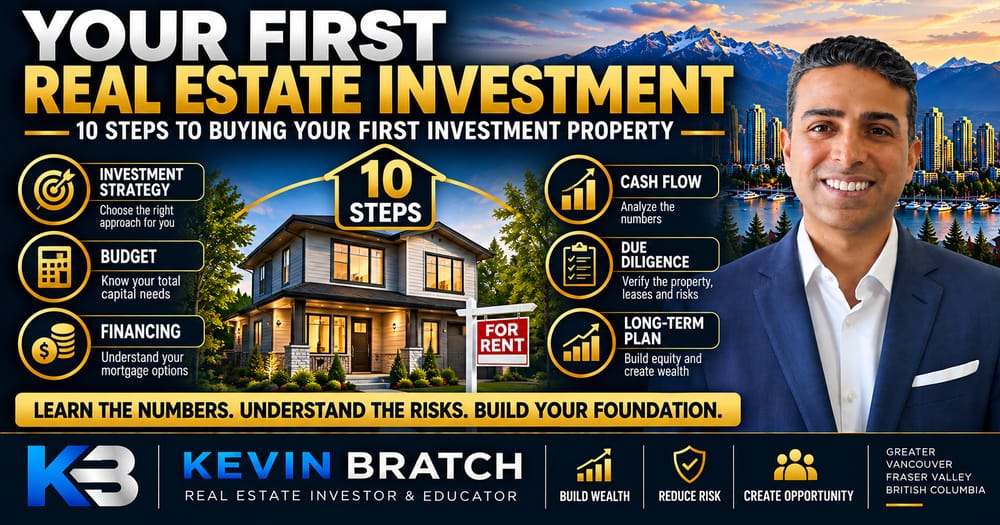
In this guide, I'll walk you through 10 practical steps to buying your first investment property, including how to evaluate the numbers, avoid common mistakes and build a stronger investment foundation.
Your first investment should be based on a clear strategy and realistic numbers, not excitement or fear of missing out.
For additional resources and interactive calculators, visit my First Real Estate Investment Guide.
Key Takeaways
- Choose an investment strategy before choosing a property.
- Calculate all required capital, not just the down payment.
- Understand mortgage qualification before making an offer.
- Analyze cash flow using realistic income and expenses.
- Complete thorough property, financial and legal due diligence.
- Keep reserves for vacancies, repairs and unexpected costs.
- Have a clear holding plan and exit strategy.
Choose Your Real Estate Investment Strategy
Before looking at properties, decide what you want the investment to accomplish.
Different real estate strategies require different amounts of capital, experience, time and risk tolerance.
Buy and Hold
Purchase a property with the intention of renting it over the long term. Potential benefits may include rental income, mortgage principal repayment and property appreciation.
BRRRR Investing
Buy, renovate, rent, refinance and repeat. This strategy involves renovation, valuation and refinancing risks, and may be more complicated for beginners.
Fix and Flip
Purchase a property, improve it and sell it. Success depends on acquisition price, renovation costs, carrying costs, market conditions and the final sale price.
Joint Venture Investing
Two or more parties may combine capital, experience or financing capacity to pursue an investment. Clear legal agreements and defined responsibilities are essential.
Explore the Real Estate Investment Strategies Guide to compare different approaches.
Choose the strategy first. Then find a property that fits it.
Calculate How Much Capital You Actually Need
One of the biggest beginner mistakes is focusing only on the down payment.
Buying an investment property can require additional funds for closing costs, repairs, renovations and cash reserves.
For example, imagine purchasing a hypothetical rental property for $750,000.
| Initial Investment Requirement | Amount |
|---|---|
| Purchase price | $750,000 |
| Down payment (20% assumption) | $150,000 |
| Estimated closing costs | $15,000 |
| Renovation budget | $25,000 |
| Initial repairs | $5,000 |
| Cash reserves | $15,000 |
| Total capital required | $210,000 |
This hypothetical example requires $210,000 in available capital, including the $15,000 intended to remain in reserves.
The actual down payment requirement depends on the property, occupancy, borrower and lender. The 20% figure is an illustrative assumption, not a universal financing rule.
Closing costs also vary by transaction. In BC, applicable property transfer tax, legal fees, inspections and other expenses can materially affect the total.
Why Cash Reserves Matter
What happens if the property sits vacant for two months?
What if the furnace fails?
What if an unexpected repair costs $10,000?
Investors who use nearly all their available capital to close a purchase may have little flexibility when unexpected expenses arise.
Cash reserves help protect your ability to continue owning the investment.
Try the First Investment Budget Calculator
Estimate your down payment, mortgage amount, closing costs, renovations, repairs and reserves using the interactive calculator on my First Real Estate Investment Guide.
Understand Your Investment Property Financing Options
Financing should be evaluated before making offers, not after finding a property you want to buy.
Lenders may consider:
- Your income and employment or business history
- Credit history
- Existing mortgages and other debts
- Down payment amount and source
- Property type and condition
- Expected or existing rental income
- Debt-service ratios and lender requirements
Conventional Investment Mortgage
A bank, credit union or other institutional lender may provide financing, subject to underwriting and property eligibility.
Using Existing Property Equity
Some investors access equity through refinancing or a home equity line of credit. This can increase available capital but also adds borrowing obligations and potentially places existing assets at risk.
Private Lending
Private financing may be available for certain situations, but fees, interest rates, loan terms and repayment requirements can differ significantly from conventional mortgages.
Joint Venture Partnerships
A partnership may combine an investor's capital with another party's experience, management or financing capacity. All parties should understand their legal rights, contributions and risks.
Learn more about Private Lending and Real Estate Joint Ventures.
Speak with a qualified mortgage professional to understand realistic financing options before shopping for a property.
Choose the Right Type of Investment Property
Not every property type is equally suitable for a first-time investor.
The best choice depends on your capital, strategy, experience and willingness to manage the investment.
Single-Family Rental Property
A familiar residential property type that may be straightforward to understand. However, income may depend on one household, and vacancy can temporarily eliminate rental revenue.
Explore Single-Family Real Estate Investing.
Duplex
A duplex may offer two separate rental income streams, potentially reducing dependence on one tenant. Investors still need to evaluate both units, legal status, financing and maintenance.
Explore Duplex Real Estate Investing.
Condominium Investment
Condominiums may involve less direct responsibility for certain shared building maintenance, but strata fees, bylaws, financial statements, insurance and special levies require careful review.
Small Multi-Family Property
Properties with several units may offer more diversified rental income, but often involve greater capital requirements and management complexity.
Explore Multi-Family Real Estate Investing.
Value-Add Property
Properties requiring renovations may offer opportunities to improve value or income. However, renovation budgets, permits, financing and unexpected repairs can create significant risk.
The right first property is not necessarily the one with the highest projected return.
It is the one whose risks and financial requirements you can reasonably understand and manage.
Research the Location and Rental Market
Real estate is a local investment.
A property that performs well in one neighbourhood may perform differently in another, even within the same city.
Before buying, research:
- Local rental demand
- Comparable rental listings and achieved rents
- Vacancy conditions
- Employment and population trends
- Transportation and amenities
- Neighbourhood development
- Property taxes and insurance costs
- Comparable property sales
Don't Rely on One Rental Listing
If a seller claims a property can rent for $4,000 per month, verify that estimate against genuinely comparable properties.
Consider the number of bedrooms, property condition, parking, location, amenities and applicable tenancy restrictions.
Use conservative assumptions when rental evidence is limited.
For regional context, explore my British Columbia Real Estate Market Outlook.
Analyze the Property's Cash Flow Before Buying
One of the most important skills a beginner can develop is understanding how rental income compares with the actual cost of owning a property.
Gross rental income is not the same as profit.
Investors need to account for:
- Vacancy and collection losses
- Property taxes
- Insurance
- Repairs and maintenance
- Property management
- Strata fees, where applicable
- Owner-paid utilities
- Mortgage payments
- Major capital expenditures and reserves
A First Rental Property Cash-Flow Example
Consider a hypothetical property producing $4,000 per month in gross rental income.
| Monthly Property Performance | Amount |
|---|---|
| Gross rental income | $4,000 |
| Vacancy allowance (5%) | −$200 |
| Effective rental income | $3,800 |
| Property taxes | −$350 |
| Insurance | −$150 |
| Maintenance allowance | −$250 |
| Property management | −$250 |
| Other operating expenses | −$100 |
| Monthly NOI | $2,700 |
| Illustrative mortgage payment | −$3,000 |
| Estimated monthly cash flow | −$300 |
Under these assumptions, the property produces negative cash flow of $300 per month before income taxes and any additional capital expenditures not already included in the allowances.
This does not automatically mean the investment is unsuitable, but it does mean the owner needs to fund the shortfall and understand the risks.
− OPERATING EXPENSES
− MORTGAGE PAYMENTS
= ESTIMATED CASH FLOW
What About Appreciation?
Property appreciation may contribute to long-term returns, but it is not guaranteed.
Markets can rise, decline or remain flat for extended periods.
Mortgage principal repayment can also build equity, but equity growth is different from available monthly cash.
Investors should understand these components separately.
A property can build equity while losing money every month. Understand both before you buy.
Calculate Your Own Rental Property Cash Flow
Use my First Rental Property Cash Flow Calculator to adjust rent, mortgage assumptions, vacancy, expenses and initial investment capital.
Want to Learn More About Real Estate Investing?
Join my private investor list for off-market real estate opportunities, investment education, market insights and practical investing strategies.
JOIN THE PRIVATE INVESTOR LIST →Complete Property Due Diligence
Finding a property with attractive numbers is only the beginning.
Before completing a purchase, verify the financial, physical and legal information supporting the investment.
Property Inspection
Evaluate the roof, foundation, structure, plumbing, electrical systems, heating, drainage, windows and other major components.
Title and Legal Review
Review ownership, registered charges, easements, covenants, access rights and relevant contractual obligations with a qualified legal professional.
Zoning and Permitted Use
Confirm that the intended rental or renovation strategy is permitted under applicable municipal and provincial requirements.
Tenancy Review
If the property is already rented, review tenancy agreements, payment history, deposits and landlord obligations.
Strata Review
For strata properties, examine financial statements, budgets, bylaws, meeting minutes, insurance and potential special levies.
Insurance and Financing
Confirm that the property is insurable and meets lender requirements.
Skipping due diligence to move quickly can expose an investor to risks that outweigh any perceived purchase advantage.
Determine Your Maximum Purchase Price and Make an Informed Offer
Once you understand the property's income, expenses, condition and financing, determine what you can reasonably afford to pay.
Your maximum price should be supported by:
- Comparable property sales
- Realistic rental income
- Operating expenses
- Renovation and repair costs
- Financing terms
- Required investment returns
- Available capital and reserves
Do not allow the asking price to become your definition of value.
Where appropriate, a purchase contract may include conditions relating to financing, inspections, document review and other due diligence matters.
Work with qualified professionals to understand the contract and deadlines.
What About Off-Market Properties?
Some investors find opportunities through direct relationships with property owners, referrals and private seller networks.
Off-market transactions can sometimes offer different negotiation possibilities, but they do not automatically mean a property is discounted.
Learn more about Off-Market Real Estate Deals in BC.
A great property can still be a poor investment if you pay too much for it.
Prepare to Manage the Investment After Closing
Buying the property is only the start of ownership.
Investors need a plan for day-to-day operations, maintenance and financial management.
Tenant Management
Understand tenant screening, lease documentation, rent collection, maintenance requests and applicable tenancy regulations.
Property Maintenance
Develop a maintenance schedule and reserve funds for both routine repairs and major building systems.
Financial Tracking
Track income, expenses, mortgage payments, repairs and other costs consistently.
Professional Property Management
Some investors hire professional managers, while others manage their own properties. The choice depends on available time, experience, property complexity and budget.
Even if you plan to self-manage, consider the cost of professional management when analyzing the investment. Your circumstances may change over time.
Understand Your Long-Term Plan and Exit Strategy
Before buying your first investment property, consider what you want the investment to accomplish over the next five, ten or twenty years.
Possible strategies include:
- Long-term rental ownership
- Refinancing where financially appropriate
- Renovating to improve value or income
- Selling after a planned holding period
- Reinvesting proceeds into another property
- Participating in a properly structured joint venture
Each strategy carries different financial, tax and market risks.
Stress-Test the Investment
Ask what happens if:
- Property values decline by 10%
- Mortgage rates rise at renewal
- Rental income falls below expectations
- The property remains vacant for several months
- A major repair is required
- You need to sell earlier than planned
The objective is not to predict every future event.
It is to understand whether you have enough financial flexibility to handle reasonable downside scenarios.
Try the First Investment Profit & Risk Analyzer
Compare different assumptions for rental income, property appreciation, mortgage repayment, operating expenses and potential exit outcomes.
Common Mistakes First-Time Real Estate Investors Make
Many costly investment mistakes begin before the purchase is completed.
1. Buying Based on Emotion
Getting excited about a property can lead to overpaying or overlooking risks. Establish your investment criteria before viewing properties.
2. Underestimating Initial Capital
Down payments are only one component of the required funds. Include closing costs, repairs, renovations and reserves.
3. Assuming Rent Covers Everything
Rental income needs to cover operating costs, vacancy, financing and other ownership obligations. Run a complete cash-flow analysis.
4. Ignoring Property Condition
Major repairs can quickly reduce returns. Obtain appropriate inspections and realistic repair estimates.
5. Relying on Appreciation
Future property values are uncertain. An investment should not depend entirely on prices increasing.
6. Using Too Much Financing
Excessive debt can leave little room for unexpected costs, vacancies or higher interest rates.
7. Failing to Understand Rental Regulations
Landlord obligations, rent rules, municipal requirements and strata restrictions can affect investment performance.
8. Buying Without an Exit Strategy
Know how you expect to generate returns and what options may exist if your circumstances or market conditions change.
Sometimes the best investment decision is to walk away from a property that doesn't meet your criteria.
First Investment Property Checklist
Before You Buy
- Strategy: Have I defined my investment objective?
- Budget: Do I know my total required capital?
- Financing: Have I reviewed realistic mortgage options?
- Property Type: Does this property fit my experience and resources?
- Market: Have I verified local rental demand and comparable sales?
- Cash Flow: Have I included realistic income, expenses and vacancy?
- Condition: Do I understand immediate and future repairs?
- Legal: Have I reviewed title, tenancy and applicable rules?
- Reserves: Can I handle unexpected expenses?
- Exit: Do I understand the long-term plan and downside risks?
Frequently Asked Questions About Your First Real Estate Investment
How much money do I need to buy my first investment property in BC?
The amount depends on the purchase price, down payment requirements, financing, closing costs, repairs and reserves. Investment property mortgage requirements vary by lender, property type and occupancy. Use a complete budget rather than calculating only the down payment.
What is the best first investment property for a beginner?
There is no universally best property type. A single-family rental, condo, duplex or small multi-family property may be suitable depending on capital, experience, financing and management capacity. Choose based on the numbers and your investment objectives.
Should my first rental property have positive cash flow?
Positive cash flow can provide valuable financial flexibility, but investment decisions depend on the complete risk and return profile. If a property has negative cash flow, understand how the shortfall will be funded and whether the investment remains viable under downside scenarios.
Can I buy an investment property with less than 20% down?
Down payment requirements depend on occupancy, property type, borrower eligibility and lender or insurer rules. Some owner-occupied arrangements differ from non-owner-occupied investment purchases. Confirm the specific requirements with a qualified mortgage professional.
Is real estate investing risky for beginners?
Real estate involves risks including market declines, vacancy, unexpected repairs, financing changes, illiquidity and legal obligations. Education, appropriate reserves, due diligence and conservative financial assumptions can help investors understand and manage these risks.
Should I buy a rental property or a property to renovate and sell?
Rental investing and fix-and-flip strategies have different financing, capital, time and risk requirements. Rental investing focuses on ownership and ongoing operations, while flipping relies on acquisition, renovation and resale execution. Evaluate which approach matches your resources and experience.
What is the biggest mistake first-time property investors make?
One of the most costly mistakes is purchasing without fully understanding the numbers. Investors should evaluate purchase costs, financing, rental income, expenses, property condition, reserves and downside scenarios before committing.
Can I invest in real estate without managing the property myself?
Yes. Some investors hire professional property managers or participate in properly structured partnerships. However, management fees, partner obligations, investment risks and legal responsibilities still need to be understood.
Final Thoughts: Your First Investment Is About Building a Foundation
Buying your first investment property is not a competition to see who can purchase real estate the fastest.
The goal is to make a decision that supports your financial objectives and gives you the ability to manage the investment over time.
Start with your strategy.
Understand your budget.
Review financing.
Research the market.
Analyze the cash flow.
Complete due diligence.
And always understand the risks before committing capital.
Your first investment can be an opportunity to develop the knowledge and experience that may support future investment decisions.
LEARN THE NUMBERS. UNDERSTAND THE RISKS. BUILD YOUR INVESTMENT FOUNDATION.
Ready to Take the Next Step in Real Estate Investing?
Join my private investor list for investment education, off-market real estate opportunities, market insights and practical strategies to help you become a more informed investor.
JOIN THE PRIVATE INVESTOR LIST →Greater Vancouver • Fraser Valley • British Columbia
About the Author: Kevin Bratch is a Canadian real estate investor and educator with more than 20 years of real estate experience, focused on investment education, off-market opportunities and real estate strategies in British Columbia. Learn more about Kevin.
Disclaimer: This article is provided for educational purposes only and does not constitute investment, legal, tax or mortgage advice. All financial examples are hypothetical. Real estate investing involves risk, and investment outcomes are not guaranteed. Consult qualified professionals before making investment decisions.